Both can hurt. A careful examination helps reveal how and why movement is limited.
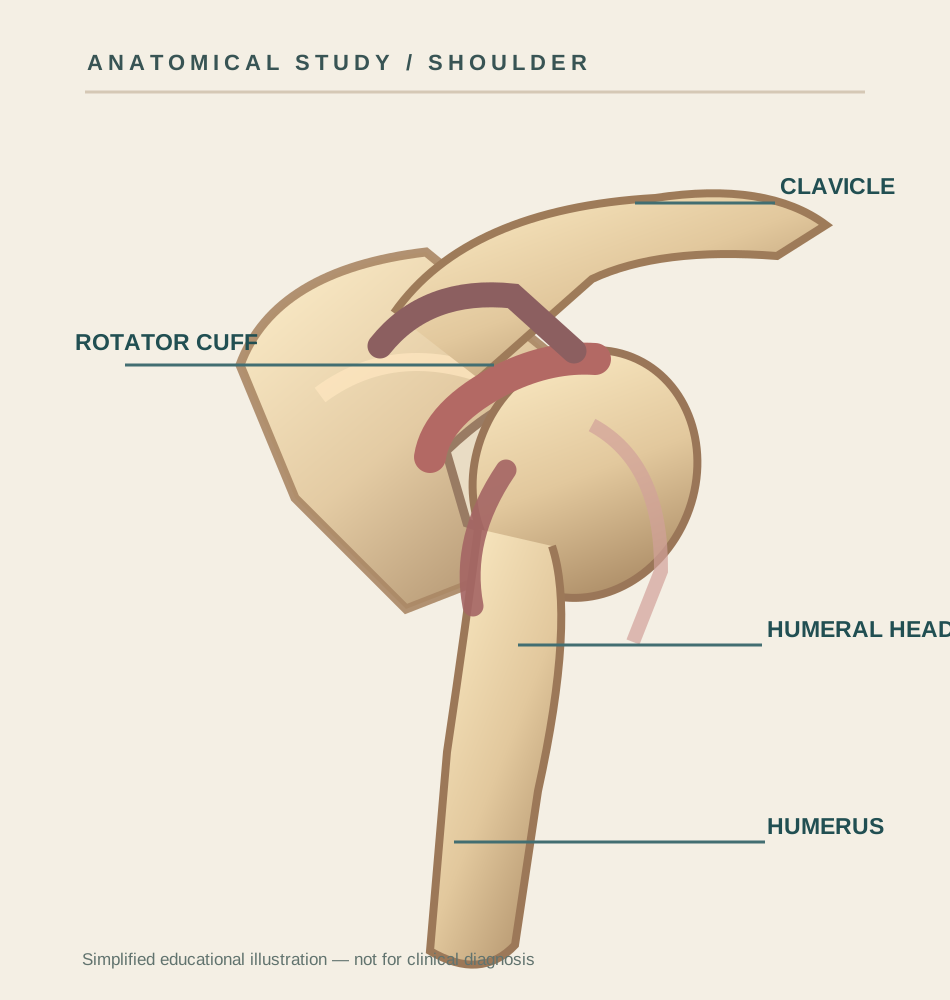
Pain and movement tell different stories
Frozen shoulder usually involves restricted active and passive movement. Rotator cuff conditions can cause pain and weakness, especially in specific directions, while passive motion may be better preserved.
The history matters
Gradual onset of marked stiffness differs from a sudden injury followed by weakness. Neither pattern is conclusive by itself because several disorders can overlap.
What imaging can and cannot answer
An X-ray can help assess bony problems, while ultrasound and MRI can be useful when tendon injuries are suspected. A scan alone does not establish which abnormality is causing symptoms.
The treatment plan should match the diagnosis
Movement rehabilitation and pain management may be important in both conditions but the pace and emphasis can differ. A clinician should evaluate persistent painful stiffness before forceful stretching or loading.
Why passive movement matters
During an examination the clinician may move your relaxed arm to assess whether stiffness persists without active muscle effort. Loss of passive movement can be a useful finding when considering adhesive capsulitis.
Can both conditions occur together?
More than one shoulder problem can exist at the same time. A diagnosis should account for the full clinical picture instead of assuming an MRI finding or a single movement test explains everything.
Questions to bring to your specialist
- Which possible diagnosis best explains my specific symptoms?
- Will any imaging alter the plan?
- What are the available options and expected trade-offs?
- What changes should prompt an earlier review?